Realistic Landscape Coloring Guide for Beginners & Kids
26 de agosto de 2026
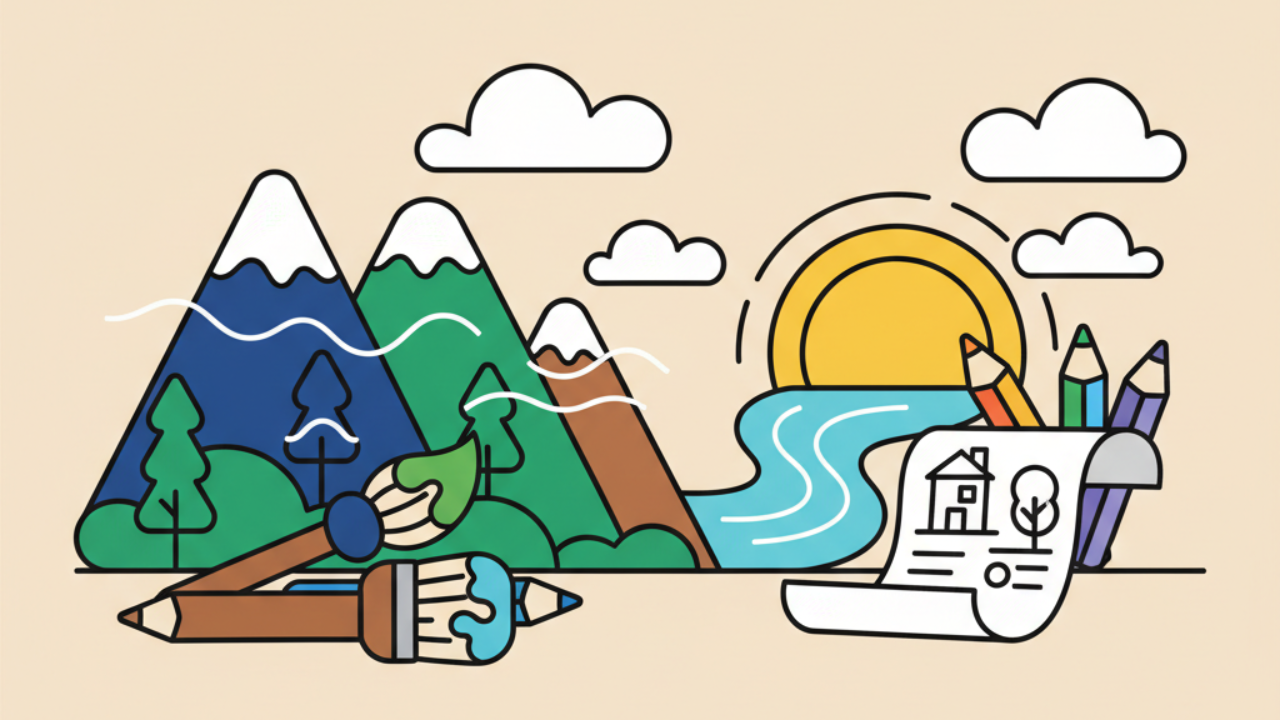
Learn how to color beautiful landscape pages with our easy guide. Download and print free realistic coloring sheets for kids and beginners to enjoy! 🎨🏞️
Why Coloring Landscapes Boosts Creativity
Coloring landscapes is one of the most enriching activities for both children and adults. Unlike specific characters, natural scenery offers unprecedented artistic freedom. At Coloring and Drawing Fun, we believe that every mountain, tree, or river represents an opportunity to explore new color palettes and unique textures.
When we focus on free printable coloring pages depicting the environment, we encourage detailed observation. Children begin to notice that the sky isn't just blue and that grass has various shades of green. This visual perception is fundamental for artistic and cognitive development.
Furthermore, nature-themed coloring sheets act as a relaxing therapy. In an increasingly digital world, sitting down with a set of colored pencils and a printed page helps reduce stress and improve concentration, making it an excellent choice for teachers to use in the classroom as educational coloring activities.
Ideal Materials for Painting Realistic Landscapes
To achieve a realistic effect in your printable art, the choice of material makes all the difference. While crayons are great for quick fills, watercolor pencils allow you to create smooth gradients that professionally simulate a sunset or the movement of water.
If you prefer to color online, our digital tools offer brushes that mimic the texture of oil and acrylic, making it easier for those who desire convenience. However, for those who love paper, we recommend using paper with a grammage above 90gsm to prevent marker or watercolor ink from bleeding through the sheet.
Printing Tip: When downloading your cute coloring pages of landscapes from Coloring and Drawing Fun, set your printer to 'High Quality' or 'Photo'. This ensures that the kids' line art retains all the subtle details of rock and foliage textures.
Shading Techniques for Mountains and Clouds
The secret to a realistic landscape lies in light and shadow. To paint mountains, choose one side to be the light source and keep the opposite side in darker tones. Use shades of gray, dark blue, and purple to create depth in rock crevices, leaving the peak lighter.
For clouds, the trick is not to leave them entirely white. Use a very light blue or soft gray at the base of the cloud to give it volume. Remember that in nature-themed coloring activities, organic shapes rarely have perfect straight lines, so feel free to smudge the outlines with your finger or a cotton swab.
The Importance of Colors in Atmospheric Perspective
Have you ever noticed that distant mountains appear more bluish or grayish? This is called atmospheric perspective. When using our AI-generated coloring pages that create deep scenarios, apply vibrant colors to objects in the foreground (close to the observer) and paler, cooler colors in the background.
This technique creates the illusion of three-dimensional space on a two-dimensional sheet of paper. It's an excellent way to simultaneously teach basic physics and art through digital coloring books or printed ones. Try mixing earthy tones on the ground nearby and misty tones on the horizon.
- Foreground: Saturated colors, sharp details, intense greens, and dark browns.
- Midground: Neutral colors, moderate details, smooth transitions.
- Background: Light blue, lavender, gray tones, and less defined outlines.
- Sky: Gradients ranging from intense blue at the top to almost white blue near the horizon.
How to Represent Different Seasons
Taking advantage of the current season, we can adapt our coloring sheets to reflect it. Even if we don't have snow, the light of autumn and winter can be softer, calling for more pastel and golden colors in sunset drawings.
If you're coloring a forest scene, you might opt for dry tones to represent local vegetation or vibrant flowers to anticipate spring. Coloring and Drawing Fun offers versatile options so you can print the same landscape multiple times and color it in different seasonal contexts.
Creating Water Textures: Rivers and Lakes
Painting water can seem challenging, but the secret lies in reflections. Use short, horizontal strokes to represent the movement of waves on a lake. If the landscape has a flowing river, use curved lines that follow the water's flow. Leave small white spaces to simulate the sun's glare reflecting on the surface.
For a transparency effect, paint the riverbed with ochre or moss green tones and layer turquoise blue over it. This layering technique is highly valued in more detailed kids' line art, as it teaches children patience and precision with pencils.
Educational Benefits of Landscape Coloring Activities
Teachers find educational coloring pages of natural scenery a powerful tool for teaching geography and biology. By coloring a specific biome, such as the Amazon or the savanna, students better grasp the characteristics of local fauna and flora.
Furthermore, fine motor skills are exercised when filling in small areas, such as tree leaves or tiny stones on a path. On the Coloring and Drawing Fun website, we facilitate access to these materials so that learning is fun and visually appealing.
- Development of patience and sustained focus.
- Stimulation of natural pattern recognition.
- Improvement in depth and scale perception.
- Emotional expression through subjective color choices.
- Connection with environmental preservation themes.
Using Artificial Intelligence to Create Unique Landscapes
One of the great innovations at Coloring and Drawing Fun is the integration of AI-generated coloring pages. If you haven't found the exact landscape you imagined, our technology allows you to generate personalized coloring sheets based on your descriptions.
This means you can request a 'mystical waterfall between crystal mountains' and receive exclusive line art to print. This functionality combines modern technology with the traditional practice of coloring, ensuring there are always new challenges for little artists and collectors of printable art.
Tips for Coloring the Sky Realistically
The sky is rarely a single color. Start with a darker shade at the top of the page and gradually lighten it as you move down towards the horizon line. If you're coloring a sunset, the color sequence usually follows: dark blue, purple, pink, orange, and yellow near the sun.
Avoid using black for shadows in the sky; instead, use shades of navy blue or deep violet. This maintains the vibrancy of the drawing and prevents the landscape from looking dirty or dull. Practicing these gradients is what differentiates a beginner's drawing from a realistic work of art.
How to Assemble a Landscape Coloring Book
You can create your own digital coloring book or physical one by selecting your favorite drawings from our portal. Simply download the PDF files, print for free, and bind them. This creates a portfolio of progress where children can see their technical evolution over the weeks.
Having a central theme, like 'Landscapes of the World,' motivates continued activity. You can include everything from tropical beaches to snowy mountains and dense forests. The diversity of scenarios available at Coloring and Drawing Fun ensures that every page is a new visual adventure.
Frequently Asked Questions
How do I prevent drawings from smudging when coloring?
To prevent smudges, always start coloring from the top of the page downwards (if you're right-handed, from left to right). This prevents your hand from dragging over graphite or fresh ink, keeping the coloring sheet clean.
Can I use watercolor on regular printer paper?
Regular paper (75gsm copy paper) tends to wrinkle with water. If you want to use watercolor, it's ideal to print coloring pages on specific mixed-media papers or heavier grammage papers, such as 120gsm or 180gsm, which can withstand moisture without deforming.
Where can I find AI landscape drawings?
In the main menu of Coloring and Drawing Fun, we have a section dedicated to AI-generated coloring pages. There, you can explore galleries created by cutting-edge technology that offer fantastic and realistic scenarios impossible to find in common books.
What are the best colors for landscape beginners?
We recommend starting with a basic kit of 12 or 24 colors that includes several shades of green, blue, and brown. Having variations of the same color makes it easier to create depth and shadows without the need for complex mixing initially.
Now that you know the best techniques to bring natural scenery to life, it's time to get hands-on! Explore our vast gallery at Coloring and Drawing Fun, choose your favorite scenes, and start printing for free right now. Unleash your imagination and turn every blank sheet into a vibrant work of art!
Escrito e revisado por Armando Amaro
Fundador do Desenhando e Colorindo. Todo artigo passa por curadoria e revisão humana antes de ser publicado.