Master the Art of Drawing a Detailed Ocean for Coloring
26 de outubro de 2026
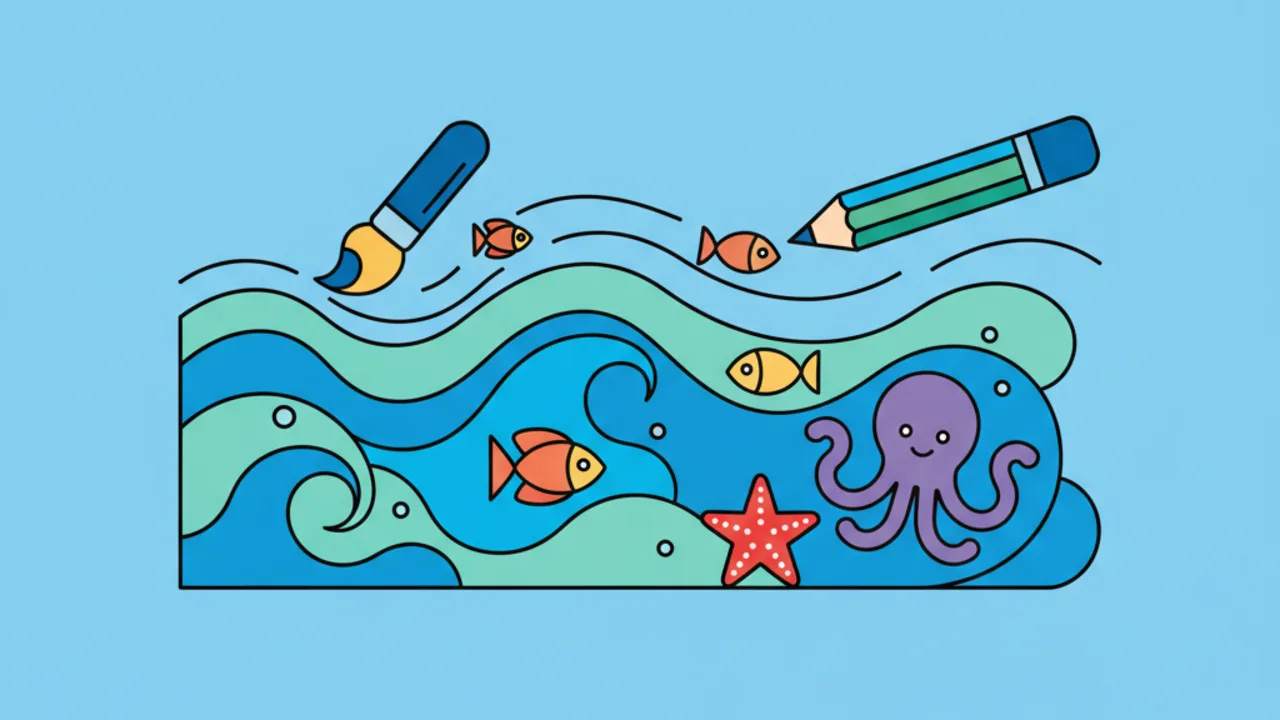
Unlock expert tips for drawing realistic oceans and creating your own coloring pages. Level up your art with waves and sea life! 🌊🐢
Exploring the world of ocean coloring pages is one of the most relaxing ways to spark your creativity. Drawing a detailed sea requires paying attention to fluid shapes and the various elements that make up the oceanic ecosystem. As we get into the beach season, printable coloring pages featuring oceans and seashores become top favorites for kids and educators alike.
Understanding wave anatomy for kids' line art
To create high-quality line art for kids, the first step is understanding the movement of water. Waves aren't just straight lines; they have sinuous curves that suggest volume and power. Start by sketching slightly wavy horizontal lines to represent a calm horizon.
When drawing breaking waves, use a long, inverted "C" shape. This provides the necessary depth so that, when it's time to use the coloring sheets, children can easily tell the difference between the crest of the wave and the base of the water.
Adding sea foam and surface textures
Sea foam is the detail that brings any digital coloring book or printed page to life. Instead of continuous lines, use small, irregular circles and clustered semicircles at the top of the waves. This creates a rich visual texture that challenges fine motor skills during coloring activities.
Marine life elements to enrich your composition
A detailed sea wouldn't be complete without the life that inhabits it. Integrating marine animals transforms a simple drawing into a complex narrative scene. You can include tropical fish, leaping dolphins, or even whales in the background to give the ocean a sense of scale.
When creating these educational drawings, remember to keep the lines clear and well-defined. This makes it easier to use colored pencils, crayons, or even the online coloring feature directly on the Desenhando e Colorindo website.
- Fish: Small triangles for tails and oval shapes for the body.
- Coral: Organic shapes that look like underwater tree branches.
- Shells: Spirals and radial lines to add detail to the sand.
- Starfish: Soft pentagons that serve as a base for coloring.
Pro tip: When drawing for toddlers, keep the coloring areas larger. For adults looking for relaxation, add hatching patterns inside the waves to create natural shadows.
Perspective and depth in coloring pages
Depth is what separates an amateur sketch from a professional-grade free printable coloring page. Use the rule of the horizon: elements closer to the bottom of the page should be larger and more detailed, while elements near the horizon line should be smaller and simpler.
Whether you are developing AI-generated drawings or freehand art, ensure the sky and sea have a clear separation but interact through soft reflections, represented by short, horizontal strokes on the water's surface.
Using sand and the seabed
Don't forget what lies beneath the surface. Drawing the seabed with rocks and aquatic vegetation allows printable art to offer a wider variety of colors, from deep blue to the earthy tones of sand and the green of seaweed.
Shading techniques for free drawings
Although we are creating outlines for coloring, variable line weights help indicate shadow. Thicker lines at the base of waves suggest darker, deeper areas, while thin lines on the surface indicate bright light reflecting from the sun.
This technique is essential for those looking for cute drawings that maintain a three-dimensional look. When giving the material to students, explain how pencil pressure can simulate these different intensities of blue suggested by your original strokes.
How to structure a complete marine scene
For a balanced scene, divide your page into three parts: the sky, the water surface, and the seabed. This division is ideal for school coloring activities, as it allows teachers to work on different geographical and biological concepts with students.
- Sky: Include fluffy clouds and perhaps a radiant sun to light up the scene.
- Surface: Focus on waves, sailboats, or sea birds.
- Underwater: Explore the diversity of corals and deep-sea fauna.
The importance of educational drawings in child development
Drawing and coloring the sea isn't just fun; it's an exercise in observing nature. Through printable coloring pages, children learn about environmental preservation and the beauty of ecosystems. Desenhando e Colorindo values offering content that stimulates this ecological awareness in a playful way.
When printing your drawings, prefer 24lb (90g) paper or higher if using markers, to prevent the ink from bleeding through and ruining your workspace.
Frequently Asked Questions
How do I make waves look real on paper?
To add realism, use curved lines and avoid repetitive patterns. Nature is irregular, so draw waves of different sizes and heights to create a dynamic look in your coloring pages.
What materials are best for coloring the sea?
Watercolor pencils are excellent for creating a water transparency effect. If you're using our free coloring pages, try mixing different shades of blue, cyan, and teal.
Can I use these techniques for AI-generated drawings?
Yes! When providing prompts for AI drawings, use terms like "detailed marine line art," "clear black outlines," and "coloring book style" to get print-ready results.
Where can I find more ocean drawings to print?
You can access the nature category on Desenhando e Colorindo to find a vast library of free drawings with maritime themes, from tropical beaches to deep-sea abysses.
Now that you've learned the best techniques to draw and detail an amazing sea, how about putting them into practice? Visit our full gallery, pick your favorites, and start your coloring activities right now. Don't forget to share your masterpieces with us and explore the entire universe of free printable coloring pages we've prepared for you and your family! 🌊🎨
Escrito e revisado por Armando Amaro
Fundador do Desenhando e Colorindo. Todo artigo passa por curadoria e revisão humana antes de ser publicado.